Seminar: ENS, Paris
Condensation du chrome et collisions assistées par champs radio-fréquence

Condensation du chrome et collisions assistées par champs radio-fréquence
Dipolar relaxation in a chromium Bose-Einstein condensate
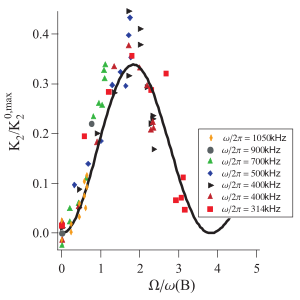
We develop a theoretical model to describe the radio-frequency (RF) induced coupling of a pair of colliding atoms to a Feshbach molecule when a magnetic field arbitrarily far from the Feshbach resonance is modulated in time.
arXiv:0812.4355 (2008) / Eur. Phys. J. D 56, (2010)
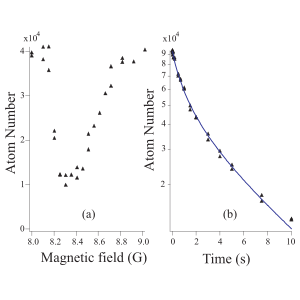
We analyze a narrow Feshbach resonance with ultracold chromium atoms colliding in 𝑑 wave. The resonance is made possible by dipole-dipole interactions, which couple an incoming 𝑙=2 collision channel with a bound molecular state with 𝑙=0.
arXiv:0811.4282 (2008) / Phys. Rev. A 79, 032706 (2009)
Bose-Einstein condensation in chromium and rf-assisted dipolar collisions
Studying dipolar effects in degenerate quantum gases of chromium atoms
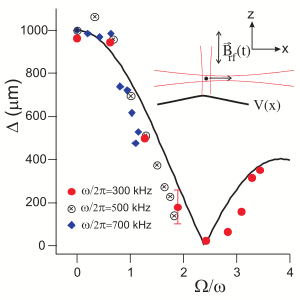
We study the effect of strong radio-frequency (RF) fields on a Bose-Einstein condensate (BEC) of chromium atoms, in a regime where the RF frequency is much larger than the Larmor frequency.
arXiv:0808.3931 (2008) / Phys. Rev. A 78, 051603(R) (200)
Bachelor 3 internship (2 months) / Download report

Bachelor 3 internship (2 months) / Download report
All-optical production of chromium BECs – Bessel Engineering of Chromium