New arrival: Cristian Serna
A new team member arrived: welcome to Cristian Serna, who is starting his M2 internship with the superradiant lab team.
New arrival: Fatima Rahmouni
A warm welcome to Fatima Rahmouni, the new postdoc of the chromium BEC lab! She is in charge of the big upgrade to v2.0 of the chromium experiment.
New arrival: Lily Marquié
Welcome to Lily Marquié, starting her PhD on the strontium apparatus!
QuRIOUS doctoral network
We celebrate the success of the Qurious doctoral training network: we now have partners all across Europe, with whom to develop a new generation of atomic clocks and train 15 PhDs. More informations on the network at https://www.quriousclocks.eu/ and on thesis opportunity in our group here.
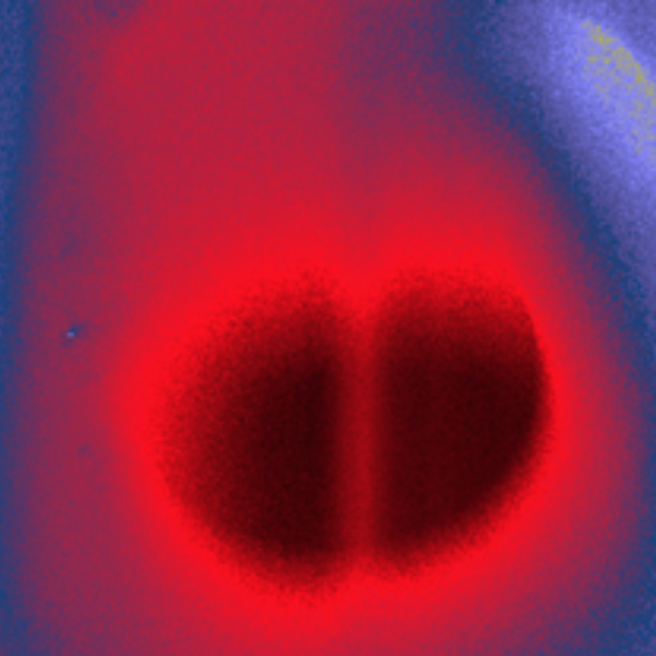
The atomic beam crosses the cavity mode.
The preparation of the atoms in the excited state, before they enter the cavity, seems to work. Efforts are under way to laser-cool further the atomic velocity distribution, in directions transverse to the atomic beam flow.
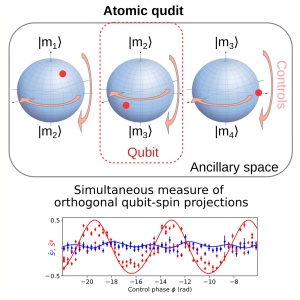
Coherent control over the high-dimensional space of the nuclear spin of alkaline-earth atoms
We demonstrate coherent manipulation of the nuclear degrees of freedom of ultracold ground-state strontium-87 atoms, thus providing a toolkit for fully exploiting the corresponding large Hilbert space as a quantum resource and for quantum simulation experiments with 𝔰u(𝑁)-symmetric matter.
arXiv:2501.01731 (2025) / PRX Quantum 6, 020352 (2025)
Generators of the SU(10) group
Now, with the implementation of evolution operators deriving from the generators of the SU(10) group, complete control over the quantum state of the nuclear spins is achievable. This is an opportunity to use the full Hilbert space of strontium 87 atoms in experiments and for quantum technologies, that we explore in our published paper. For example, we use it to measure simultaneously two non-commuting observables of pseudo-spin ensembles!
New arrival: Zeyuan Zhang
Welcome to Zeyuan Zhang, the new post-doctoral researcher joining the superradiant laser!
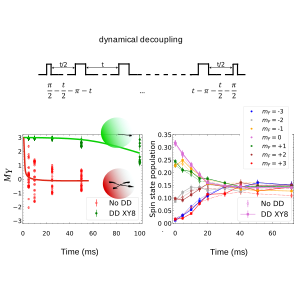
Probing coherences and itinerant magnetism
We use dynamical decoupling to preserve spin coherence against magnetic fluctuations, which allows us to study itinerant magnetism of lattice-trapped magnetic atoms, driven by magnetic dipole-dipole interactions, in the low-entropy and close-to-unit filling regime. The results are presented in our new paper.
Probing coherences and itinerant magnetism in a dipolar lattice gas
We report on the study of itinerant magnetism of lattice-trapped magnetic atoms, driven by magnetic dipole-dipole interactions, in the low-entropy and close-to-unit filling regime.
arXiv:2501.11402 (2025) / Phys. Rev. Lett. 136, 103401 (2026)