PhD defense: Husain Ahmed
Congratulations to Husain Ahmed for his PhD defense!
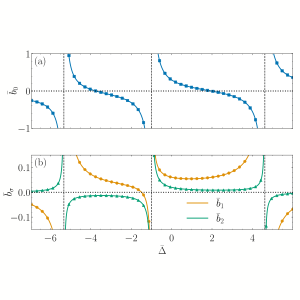
Effective light-induced Hamiltonian for atoms with large nuclear spin
In this paper, we present a systematic derivation of the effective Hamiltonian for the nuclear spin states of ultracold fermionic atoms due to such an off-resonance light. We obtain compact expressions for the scalar, vector, and tensor light shifts taking into account both linear and quadratic contributions to the hyperfine splitting.
arXiv:2404.12429 (2024) / Phys. Rev. Research 6, 033293 (2024)
New arrival: Yannis Pargoire
Welcome to Yannis Pargoire, new doctoral researcher on the superradiant laser!
New arrival: Alban Meyroneinc
Welcome to Alban Meyroneinc, new doctoral researcher on the strontium apparatus!
New arrival: Lucas Lavoine
Welcome to Lucas Lavoine, our new associate professor joining the chromium project!
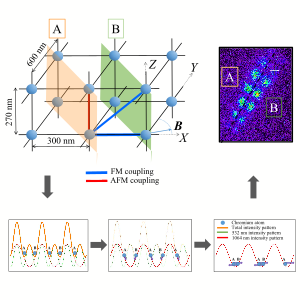
Measuring bipartite spin correlations of lattice-trapped dipolar atoms
We demonstrate a bipartition technique using a superlattice architecture to access correlations between alternating planes of a mesoscopic array of spin-3 chromium atoms trapped in a 3D optical lattice.
arXiv:2404.10531 (2024) / Phys. Rev. Lett. 133, 203401 (2024)
New arrival: Pauline Guesdon
Welcome to Pauline Guesdon, tackling the strontium project challenge for her PhD!
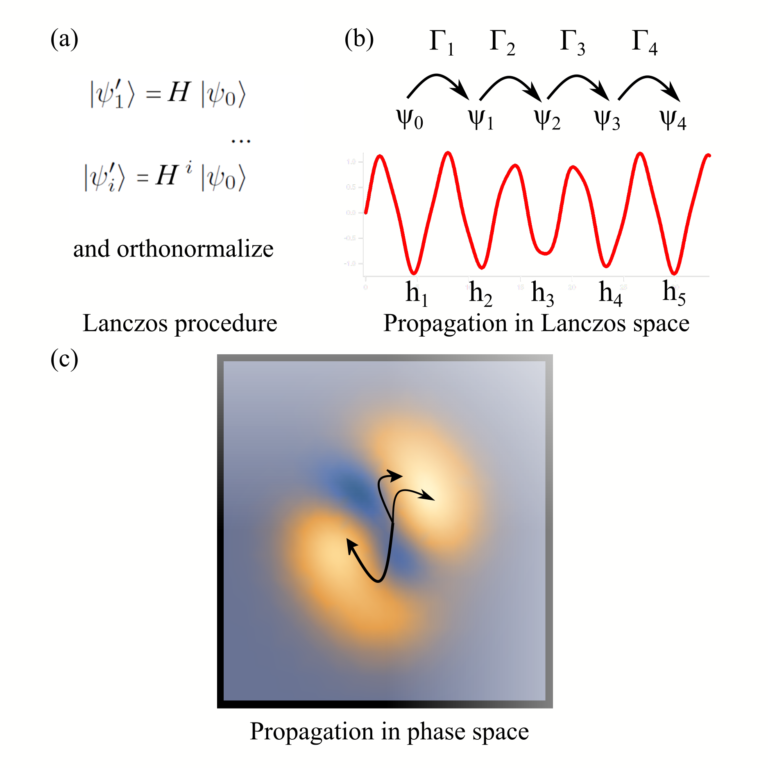
Method to discriminate between localized and chaotic quantum systems
We study whether a generic isolated quantum system initially set out of equilibrium can be considered as localized close to its initial state. Our approach considers the time evolution in the Krylov basis, which maps the dynamics onto that of a particle moving in a one-dimensional lattice where both the energy in the lattice sites and the tunneling from one lattice site to the next are inhomogeneous.
arXiv:2307.10706 (2023) / Phys. Rev. Research 6, 043045 (2024)
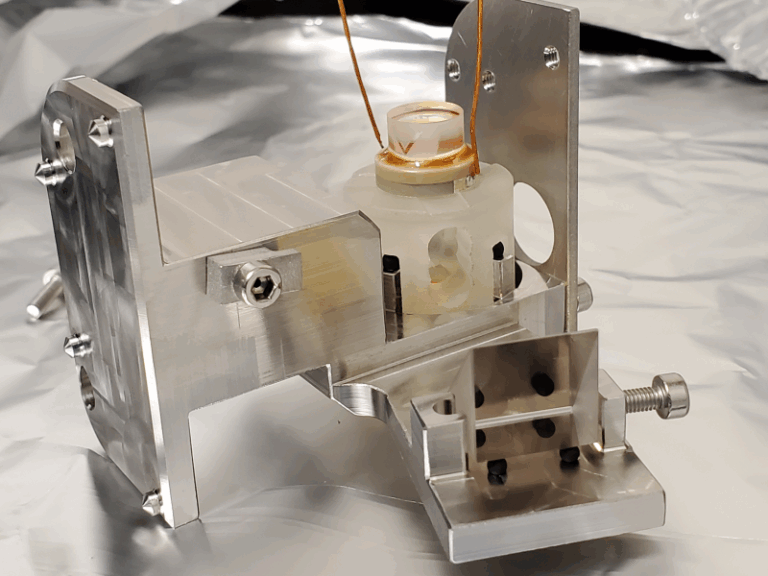
Cavity is ready for vacuum
Atoms have been seen in the main chamber, within the internship work of Arthur Ilman. The optical cavity of the superradiant laser is ready to be installed in vacuum.
PhD defense: Andrea Litvinov
Congratulations to Andrea Litvinov for his PhD defense! Have a nice new Austrian Life, at F. Ferlaino group.