Workshop: Workshop on entanglement quantification in cold gases, Vienna
Detecting entanglement in large ensembles of large spin atoms
Seminar: PHLAM laboratory, Lille
Shelving spectroscopy of the Sr intercombination line; Adiabatic spin-dependent momentum transfer in a degenerate Sr gas

Magnetic Atoms Quantum Simulators / QUANTERA CONSORTIUM MAQS
We propose to realize a novel quantum simulator made of magnetic atoms in periodic potentials, which will enable the investigation of quantum-many body problems associated with long-range dipole-dipole interactions.
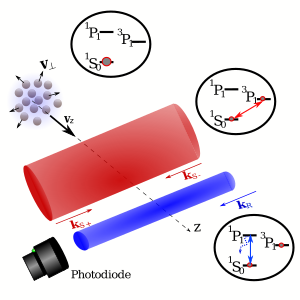
Shelving spectroscopy of the strontium intercombination line
We present a spectroscopy scheme for the 7 kHz wide 689 nm intercombination line of strontium. We rely on shelving detection, where electrons are first excited to a metastable state by the spectroscopy laser before their state is probed using the broad transition at 461 nm.
arXiv:1910.11718 (2019) / J. Phys. B: At. Mol. Opt. Phys. 53 085005 (2020)
New spectroscopy scheme
We concluded a great collaborative work with Marc Cheneau and his team, at Laboratoire Charles Fabry, on a new spectroscopy scheme for the intercombination line for strontium. For a large spectroscopy signal and a low complexity, look here.
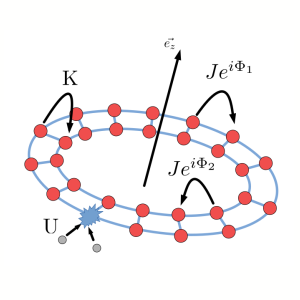
Excitation spectrum and supersolidity of a two-leg bosonic ring ladder
We consider a system of weakly interacting bosons confined on a planar double lattice ring subjected to two artificial gauge fields… Our analysis reveals supersolid features as well as Josephson modes, corresponding to out-of-phase modes of the finite ring.
arXiv:1910.06410 (2019) / Phys. Rev. A 101, 033618 (2020)
New arrival: Andrea Litvinov
Welcome to Andrea Litvinov, for his PhD on the strontium apparatus!
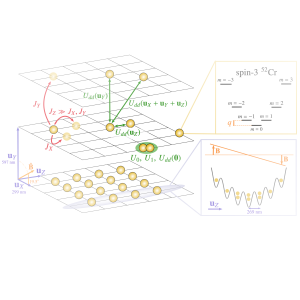
Dynamics of an itinerant spin-3 atomic dipolar gas in an optical lattice
In this work we report on our investigation of the quantum many-body dynamics of a large ensemble of bosonic magnetic chromium atoms with spin 𝑆=3 in a three-dimensional lattice as a function of lattice depth. Using extensive theory and experimental comparisons, we study the dynamics of the population of the different Zeeman levels and the total magnetization of the gas across the superfluid to the Mott insulator transition.
arXiv:1905.06123 (2019) / Phys. Rev. A 100, 033609 (2019)
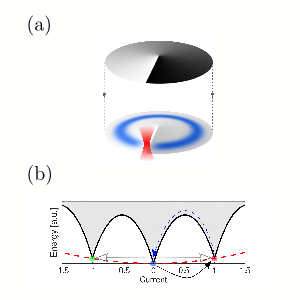
Oscillations and decay of superfluid currents in a one-dimensional Bose gas on a ring
We demonstrate coherent manipulation of the nuclear degrees of freedom of ultracold ground-state strontium-87 atoms, thus We study the time evolution of a supercurrent imprinted on a one-dimensional ring of interacting bosons in the presence of a defect created by a localized barrier.
arXiv:1903.09229 (2019) / Phys. Rev. Lett. 123, 195301 (2019)
Fermionic degeneracy
Fermionic degeneracy reached! We now produce 10-component spinor Fermi gases of strontium 87, around half the Fermi temperature.