New arrival: Esther Fromm
A warm welcome to Esther Fromm, who just started her PhD in the Chromium BEC lab!
New arrival: Cristian Serna
Welcome to Cristian Serna, who just started is PhD on the superradiant laser!

Instabilities of the continuous superradiant laser
We investigate the intensity stability of a superradiant laser in the configuration where a continuous beam of atoms in an electronically excited state crosses the mode of a high-finesse Fabry-Perot cavity. We show that such superradiant laser can become unstable and develop chaotic behavior.
arXiv:2606.21675 (2026)
New arrival: Renan Mora de Freitas
A new member arrived: Renan Mora de Freitas joined us for his M1 internship.
New arrival: Alexandre Bellon
We are welcoming Alexandre Bellon, the new member of the chromium BEC lab team.
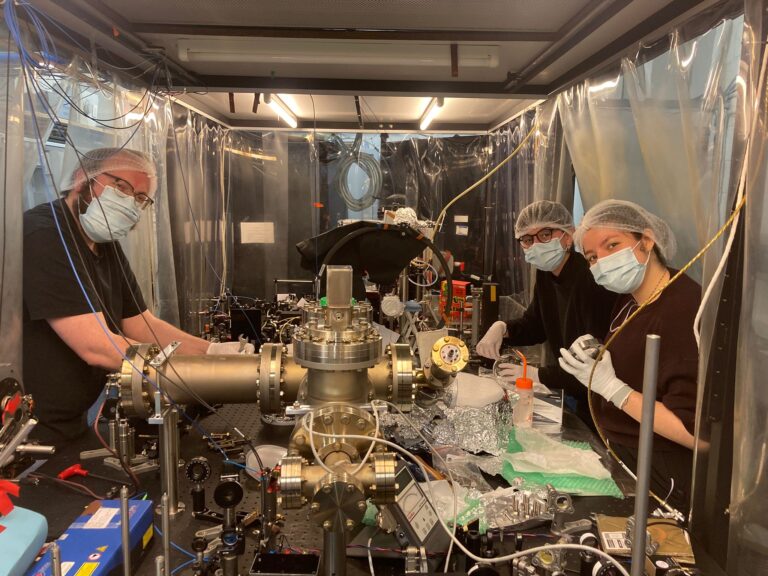
The assembly of the new vacuum chamber begins
After a long design period, we have just started the construction of the main vacuum chamber for version 2.0 of the chromium BEC experiment. The assembly is powered by our new post-doc Fatima and our summer intern Esther. Let’s hope there is no leak!

New paper out!
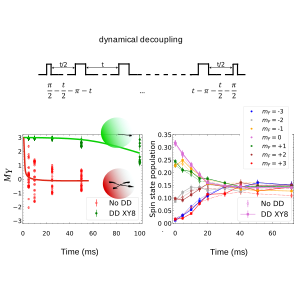
Our new paper Using dynamical decoupling to investigate magnetism of large-spin atoms from the chromium BEC lab is out. You can find it on the website Phys. Rev. A at this link.
New arrival: Esther Fromm
A warm welcome to Esther Fromm, the new member of the chromium BEC lab team.
New paper in Phys. Rev. Lett.
Our paper Probing coherences and itinerant magnetism has just been published in Physical Review Letters. You can find it at this link or on arXiv.
Using dynamical decoupling to investigate magnetism of large-spin atoms
In the low-entropy, near-unit filling regime, we employ advanced dynamical decoupling techniques to suppress magnetic-field noise and probe spin coherence across the superfluid–Mott insulator transition. Phys. Rev. A 113, 033306 (2026)