
Category Article

Coherent control over the high-dimensional space of the nuclear spin of alkaline-earth atoms

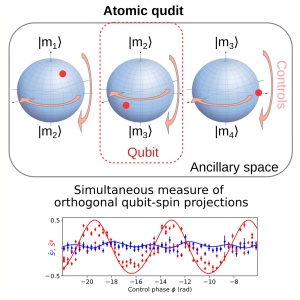
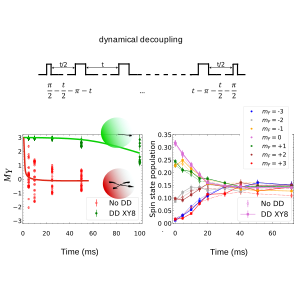
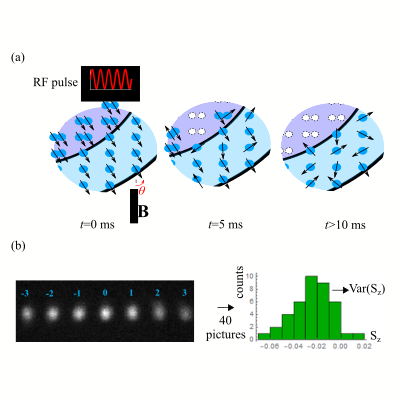
We demonstrate coherent manipulation of the nuclear degrees of freedom of ultracold ground-state strontium-87 atoms, thus providing a toolkit for fully exploiting the corresponding large Hilbert space as a quantum resource and for quantum simulation experiments with 𝔰u(𝑁)-symmetric matter.
arXiv:2501.01731 (2025) / PRX Quantum 6, 020352 (2025)

Effective light-induced Hamiltonian for atoms with large nuclear spin

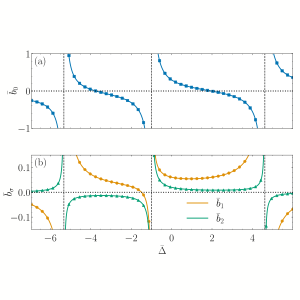
In this paper, we present a systematic derivation of the effective Hamiltonian for the nuclear spin states of ultracold fermionic atoms due to such an off-resonance light. We obtain compact expressions for the scalar, vector, and tensor light shifts taking into account both linear and quadratic contributions to the hyperfine splitting.
arXiv:2404.12429 (2024) / Phys. Rev. Research 6, 033293 (2024)

Method to discriminate between localized and chaotic quantum systems

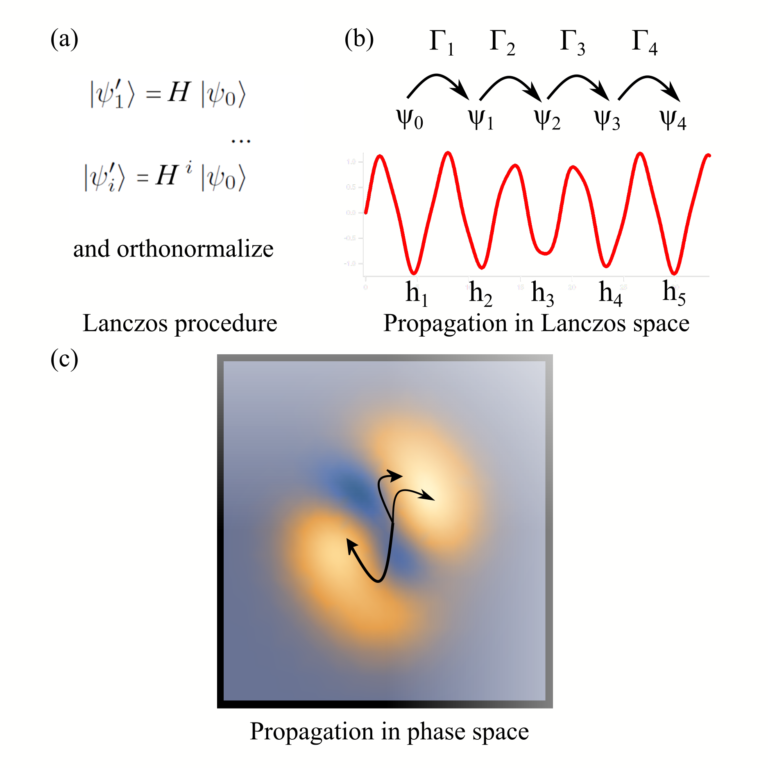
We study whether a generic isolated quantum system initially set out of equilibrium can be considered as localized close to its initial state. Our approach considers the time evolution in the Krylov basis, which maps the dynamics onto that of a particle moving in a one-dimensional lattice where both the energy in the lattice sites and the tunneling from one lattice site to the next are inhomogeneous.
arXiv:2307.10706 (2023) / Phys. Rev. Research 6, 043045 (2024)

Scalable spin squeezing from spontaneous breaking of a continuous symmetry

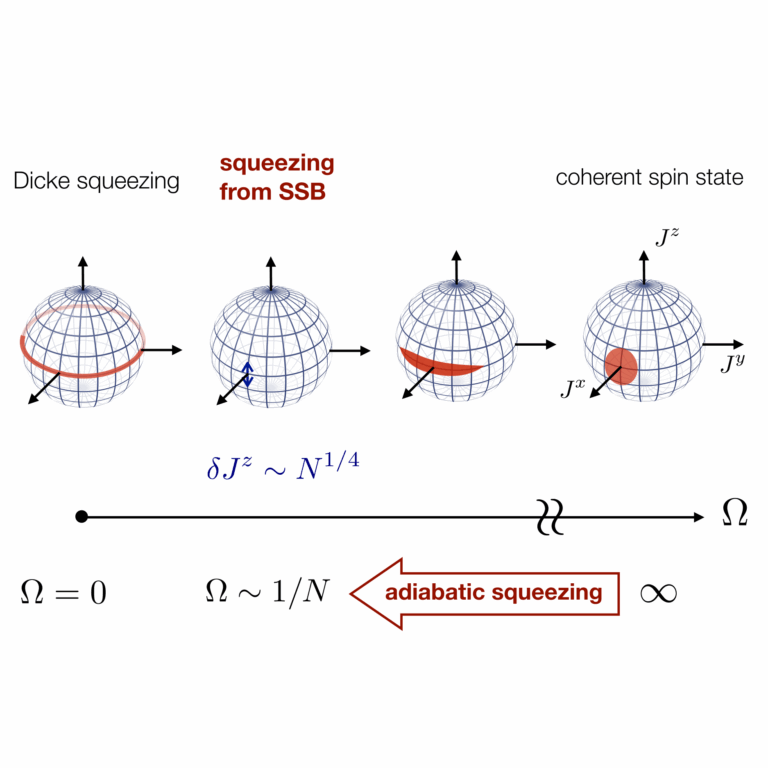
Spontaneous symmetry breaking is a property of Hamiltonian equilibrium states which, in the thermodynamic limit, retain a finite average value of an order parameter even after a field coupled to it is adiabatically turned off. In the case of quantum spin models with continuous symmetry, we show that this adiabatic process is also accompanied by the suppression of the fluctuations of the symmetry generator—namely, the collective spin component along an axis of symmetry.
arXiv:2202.08607 (2022) / Phys. Rev. Lett. 129, 113201 (2022)

Measuring densities of cold atomic clouds smaller than the resolution limit

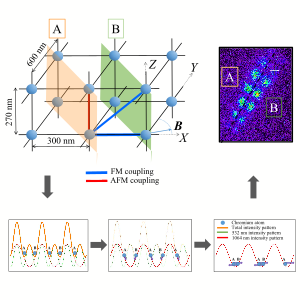
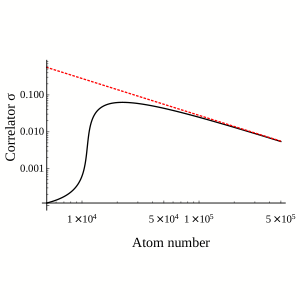
We propose and demonstrate an experimental method to measure by absorption imaging the size and local column density of a cloud of atoms, even when its smallest dimension is smaller than the resolution of the imaging system.
arXiv:2105.10296 (2021) / Physical Review A 104, 033309 (2021)