The chromium BEC lab
Overview of the chromium BEC project activities
Chromium atoms in their ground state have a large spin, and a large permanent magnetic dipole moment. The long range and anisotropic dipole-dipole interactions between the atoms confer to ultracold chromium gases (chromium BEC) unique properties.
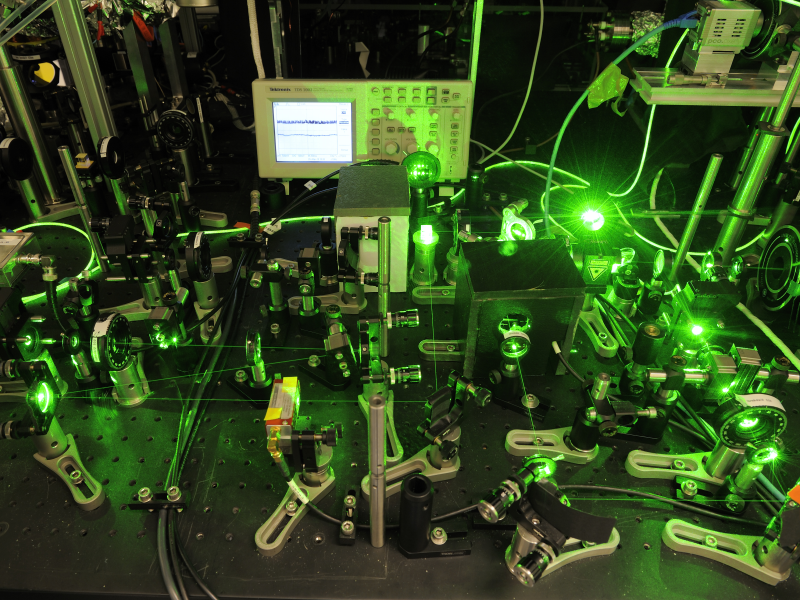
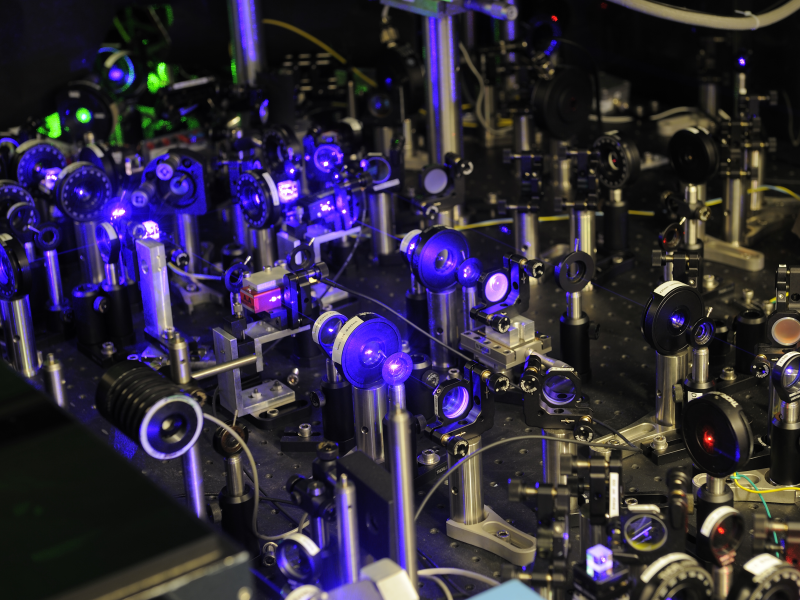
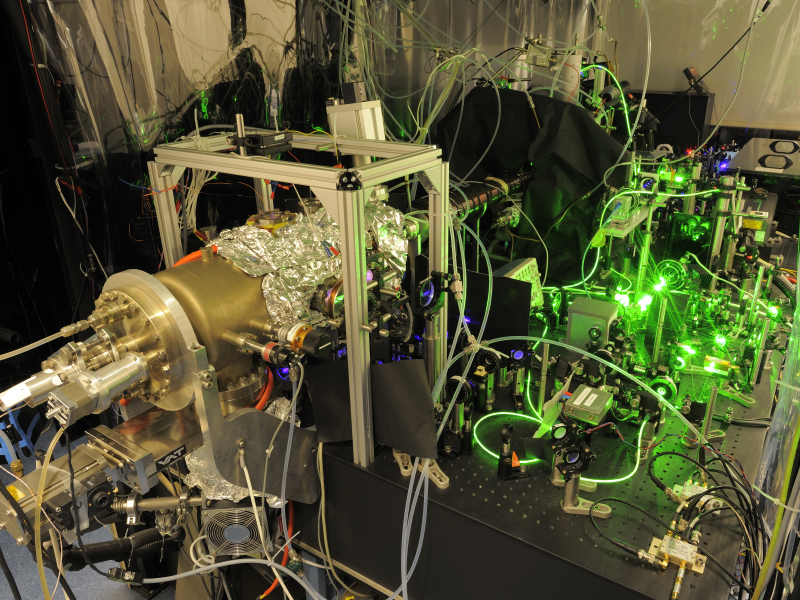
An experimental platform for quantum systems simulation
By loading a chromium BEC in optical lattices, we have obtained a Mott insulator state comprising a dipolar species, and for the first time demonstrated intersite interactions between the atoms. The dipolar spin exchange dynamics which takes place in this intrinsically many-body system is in agreement with our plaquette simulations taking into account quantum correlations. Our spin system is an excellent tool for quantum simulation, with an interplay between long-range dipolar and short range Van der Waals interactions. We varied the lattice depth from the superfluid to the Mott insulator regime to investigate the coupling between spin dynamics and transport.
Our recent research on this topic includes the study of the relaxation of spins after they are tilted with respect to their initial direction. The spins interact under the effect of dipole-dipole interactions, and the many-body system is thus an isolated system which relaxes due to inner forces. We have explored this scenario of quantum thermalization, where the final steady state corresponds to a thermal-like state whose apparent entropy is due to many-body entanglement. Our experiment is well captured by semiclassical simulations based on a discrete Monte Carlo sampling in phase space, that reveal the growth of entanglement during the thermalization process.
Control and use of the spin degrees of freedom
In a chromium BEC, inelastic dipolar collisions provide spin-orbit coupling which allows thermalizing the spin degrees of freedom. Thanks to this thermalization, we have demonstrated a new cooling mechanism, based on a purification of the BEC after transfer of thermal atoms in excited Zeeman states. We also have investigated the interplay between spin dynamics and Bose condensation to create a multicomponent BEC when a fast shock cooling process is performed on a depolarized sample.
Production of a new dipolar Fermi Sea
We have obtained the first chromium Fermi Sea with the 53Cr isotope, despite low isotopic abundance, and extreme complexity of the atomic structure due to hyperfine splitting. We have taken advantage of a favorable interspecies scattering length to optimize evaporation of a Bose Fermi mixture. Loading of dipolar fermions in optical lattices offer us new possibilities for quantum magnetism studies.
Magnetic Atoms Quantum Simulators / QUANTERA CONSORTIUM MAQS
We are coordinator of a quantera project that proposes a quantum simulator made of magnetic atoms in periodic potentials, which will enable the investigation of quantum-many body problems associated with long-range dipole-dipole interactions.
You can learn more about this project here

Introduction to the chromium BEC project:
A dipolar condensate
Our team has constructed an experimental setup to generate Bose-Einstein condensates (BECs) made of chromium atoms. These atoms bear unusual properties due to their exceptionally high magnetic dipole moment. By transferring the chromium BECs into optical lattices, we create and study artificial systems of perfect purity and valuable tunability. Indeed, we can change almost at will their temperature, density, interactions, confining potential strength and shape, etc. Such systems mimic complex systems at the heart of modern condensed matter physics, in particular those related to quantum magnetism. Furthermore, those systems are promising components for the quantum treatment of information. Ultracold atom physics is growing as a fascinating interdisciplinary domain.
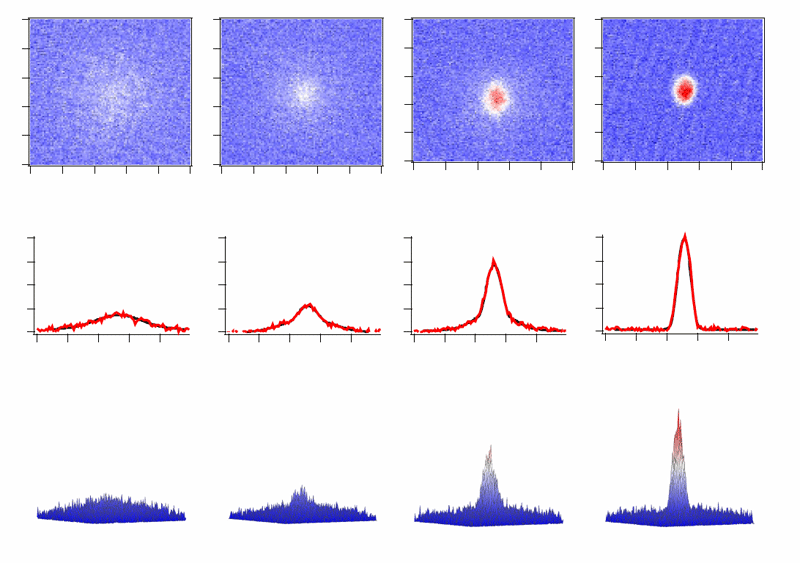
Studies using a chromium BEC
The chromium BEC allow us to performed different studies, using the specificities of chromium. The field of quantum dipolar gases offers many opportunities for research that we are exploring with a particularly strong interest for the transfer of quantum dipolar gases into optical lattices (1D, 2D and 3D).
Another attractive issue is the realization of a Fermi sea with the fermionic isotope 53Cr. We have already shown that our experimental set-up allow to prepare at the same time a mixture of cold fermions and bosons.
Project recent news
New arrival: Esther Fromm
A warm welcome to Esther Fromm, who just started her PhD in the Chromium BEC lab!
New arrival: Alexandre Bellon
We are welcoming Alexandre Bellon, the new member of the chromium BEC lab team.
The assembly of the new vacuum chamber begins
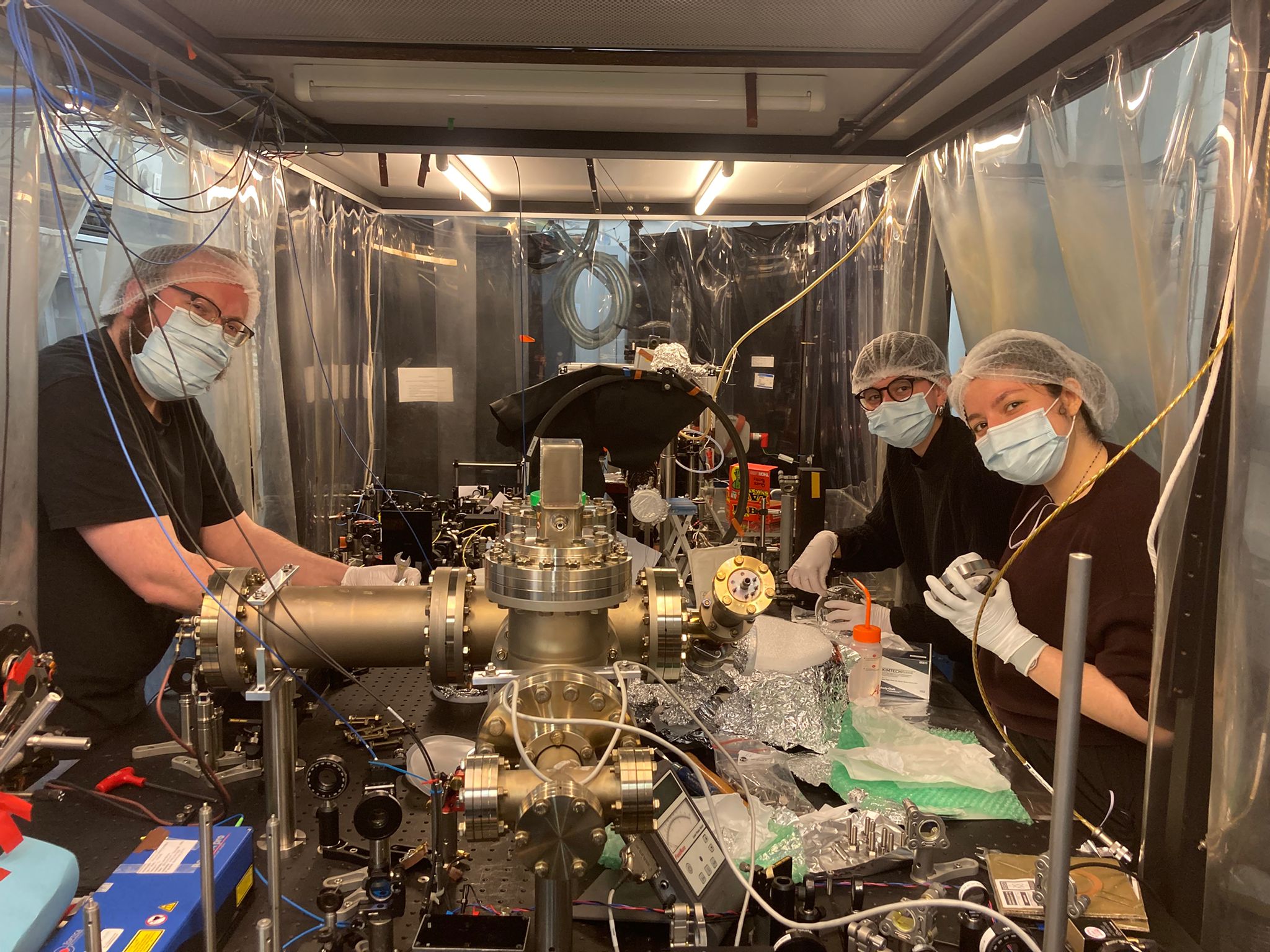
After a long design period, we have just started the construction of the main vacuum chamber for version 2.0 of the chromium BEC experiment. The assembly is powered by our new post-doc Fatima and our summer intern Esther. Let’s hope there is no leak!
New paper out!
Our new paper Using dynamical decoupling to investigate magnetism of large-spin atoms from the chromium BEC lab is out. You can find it on the website Phys. Rev. A at this link.

New arrival: Esther Fromm
A warm welcome to Esther Fromm, the new member of the chromium BEC lab team.
New paper in Phys. Rev. Lett.
Our paper Probing coherences and itinerant magnetism has just been published in Physical Review Letters. You can find it at this link or on arXiv.
Project publications
Ana Maria Rey, Bruno Laburthe-Tolra, Jose Daniel Bernal, Laurent Vernac, Thomas Lauprêtre, Youcef Baamara
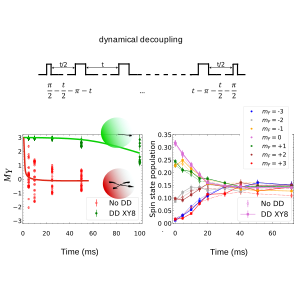
In the low-entropy, near-unit filling regime, we employ advanced dynamical decoupling techniques to suppress magnetic-field noise and probe spin coherence across the superfluid–Mott insulator transition. Phys. Rev. A 113, 033306 (2026)
Ana Maria Rey, Bruno Laburthe-Tolra, Jose Daniel Bernal, Laurent Vernac, Thomas Lauprêtre, Youcef Baamara
We report on the study of itinerant magnetism of lattice-trapped magnetic atoms, driven by magnetic dipole-dipole interactions, in the low-entropy and close-to-unit filling regime.
arXiv:2501.11402 (2025) / Phys. Rev. Lett. 136, 103401 (2026)
Ana Maria Rey, Bruno Laburthe-Tolra, Laurent Vernac, Sean Robert Muleady, Tommaso Roscilde, Youssef Aziz Alaoui, Youssef Trifa
We demonstrate a bipartition technique using a superlattice architecture to access correlations between alternating planes of a mesoscopic array of spin-3 chromium atoms trapped in a 3D optical lattice.
arXiv:2404.10531 (2024) / Phys. Rev. Lett. 133, 203401 (2024)
Ana Maria Rey, Bihui Zhu, Bruno Laburthe-Tolra, Laurent Vernac, Sean Robert Muleady, Tommaso Roscilde, William Dubosclard, Youssef Aziz Alaoui
We perform collective spin measurements to study the buildup of two-body correlations between ≈10^4 spin s=3 chromium atoms pinned in a 3D optical lattice.
arXiv:2201.07277 (2022) / Phys. Rev. Lett. 129, 023401 (2022)
We report on measurements of the dynamics of the total magnetization and spin populations in an almost unit-filled lattice system comprising about 10^4 spin 𝑆 =3 chromium atoms, under the effect of dipolar interactions.
arXiv:2005.13487 (2020) / Phys. Rev. Lett. 125, 143401 (2020)
Ana Maria Rey, Arghavan Safavi-Naini, Bihui Zhu, Bruno Laburthe-Tolra, Laurent Vernac, Lucas Gabardos, P. Blair Blakie, Petra Fersterer, Steven Lepoutre
In this work we report on our investigation of the quantum many-body dynamics of a large ensemble of bosonic magnetic chromium atoms with spin 𝑆=3 in a three-dimensional lattice as a function of lattice depth. Using extensive theory and experimental comparisons, we study the dynamics of the population of the different Zeeman levels and the total magnetization of the gas across the superfluid to the Mott insulator transition.
arXiv:1905.06123 (2019) / Phys. Rev. A 100, 033609 (2019)
We report on a scheme to cool and compress trapped clouds of highly magnetic 52Cr atoms. This scheme combines sequences of gray molasses, which freeze the velocity distribution, and free evolutions in the (close to) harmonic trap, which periodically exchange the spatial and velocity degrees of freedom.
arXiv:1812.09177 (2018) / Phys. Rev. A 99, 023607 (2019)
Bruno Laburthe-Tolra, Etienne Maréchal, Kaci Kechadi, Laurent Vernac, Lucas Gabardos, Olivier Gorceix, Paolo Pedri, Steven Lepoutre
We report on the observation of a collective spin mode in a spinor Bose-Einstein condensate.
arXiv:1804.10254 (2018) / Phys. Rev. Lett. 121, 013201 (2018)
Ana Maria Rey, Bihui Zhu, Bruno Laburthe-Tolra, Bruno Naylor, Etienne Maréchal, Johannes Schachenmayer, Laurent Vernac, Lucas Gabardos, Olivier Gorceix, Steven Lepoutre
We study the spin dynamics and approach towards local thermal equilibrium of a macroscopic ensemble of S = 3 chromium atoms pinned in a three dimensional optical lattice and prepared in a pure coherent spin state, under the effect of magnetic dipole–dipole interactions.
arXiv:1803.02628 (2018) / Nat. Commun. 10, 1714 (2019)
Ana Maria Rey, Bihui Zhu, Bruno Laburthe-Tolra, Bruno Naylor, Kaci Kechadi, L. Isaev, Laurent Vernac, Lucas Gabardos, Paolo Pedri, Steven Lepoutre
We study spin mixing dynamics in a chromium dipolar Bose-Einstein condensate, after tilting the atomic spins by an angle 𝜃 with respect to the magnetic field.
arXiv:1705.08358 (2017) / Phys. Rev. A 97, 023610 (2018)
Bruno Laburthe-Tolra, Bruno Naylor, Etienne Maréchal, Laurent Vernac, Mariusz Gajda, Miroslaw Brewczyk, Olivier Gorceix
We study the impact of spin-exchange collisions on the dynamics of Bose-Einstein condensation by rapidly cooling a chromium multicomponent Bose gas.
arXiv:1607.02406 (2016) / Phys. Rev. Lett. 117, 185302 (2016)
Arijit Sharma, Aurélie de Paz, Bruno Laburthe-Tolra, Bruno Naylor, Etienne Maréchal, Laurent Vernac, Maxim Efremov, Olivier Gorceix, Paolo Pedri
We analyze the spin dynamics of an out-of-equilibrium large spin dipolar atomic Bose gas in an optical lattice. We observe a smooth crossover from a complex oscillatory behavior to an exponential behavior throughout the Mott-to-superfluid transition.
arXiv:1507.04273 (2015) / Phys. Rev. A 93, 021603(R) (2016)
Bruno Laburthe-Tolra, Bruno Naylor, Etienne Maréchal, John H. Huckans, Laurent Vernac, Olivier Gorceix, Paolo Pedri
We propose and experimentally demonstrate a new cooling mechanism leading to purification of a Bose-Einstein condensate (BEC).
arXiv:1505.05098 (2015) / Phys. Rev. Lett. 115, 243002 (2015)
Antoine Reigue, Bruno Laburthe-Tolra, Bruno Naylor, Etienne Maréchal, Laurent Vernac, Olivier Gorceix
We report on the production of a degenerate Fermi gas of 53Cr atoms, polarized in the state 𝐹=9/2, 𝑚𝐹=−9/2, by sympathetic cooling with bosonic 𝑆=3, 𝑚𝑆=−3 52Cr atoms.
arXiv:1411.4634 (2014) / Phys. Rev. A 91, 011603(R) (2015)
Ariane Carrance, Aurélie de Paz, Bruno Laburthe-Tolra, Bruno Naylor, Etienne Maréchal, John H. Huckans, Laurent Vernac, Olivier Gorceix, Paolo Pedri
We experimentally study the spin dynamics of mesoscopic ensembles of ultracold magnetic spin-3 atoms located in two separated wells of an optical dipole trap.
arXiv:1407.8130 (2014) / Phys. Rev. A 90, 043607 (2014)
Amodsen Chotia, Arijit Sharma, Aurélie de Paz, Bruno Laburthe-Tolra, Etienne Maréchal, John H. Huckans, Laurent Vernac, Luis Santos, Olivier Gorceix, Paolo Pedri
We report on the realization of quantum magnetism using a degenerate dipolar gas in an optical lattice. Our system implements a lattice model resembling the celebrated 𝑡−𝐽 model.
arXiv:1306.2754 (2013) / Phys. Rev. Lett. 111, 185305 (2013)
Amodsen Chotia, Aurélie de Paz, Bruno Laburthe-Tolra, Etienne Maréchal, Laurent Vernac, Olivier Gorceix, Paolo Pedri
We study dipolar relaxation of a chromium Bose-Einstein condensate loaded into a three-dimensional (3D) optical lattice.
arXiv:1212.5469 (2012) / Phys. Rev. A 87, 051609(R) (2013)
Bruno Laburthe-Tolra, Etienne Maréchal, Gabriel Bismut, Laurent Vernac, Olivier Gorceix, Paolo Pedri
We measure the excitation spectrum of a dipolar chromium Bose-Einstein condensate with Raman-Bragg spectroscopy.
arXiv:1205.6305 (2012) / Phys. Rev. Lett. 109, 155302 (2012)
We study thermodynamic properties of a gas of spin 3 52Cr atoms across Bose-Einstein condensation. Magnetization is free, due to dipole-dipole interactions.
arXiv:1110.0786 (2011) / Phys. Rev. Lett. 108, 045307 (2012)
Benjamin Pasquiou, Bruno Laburthe-Tolra, Etienne Maréchal, Gabriel Bismut, Laurent Vernac, Olivier Gorceix, Paolo Pedri
We study the spinor properties of 𝑆 =3 52Cr condensates, in which dipole-dipole interactions allow changes in magnetization.
arXiv:1103.4819 (2011) / Phys. Rev. Lett. 106, 255303 (2011)
Benjamin Pasquiou, Bruno Laburthe-Tolra, Etienne Maréchal, Gabriel Bismut, Laurent Vernac, Olivier Gorceix, Paolo Pedri
We observe interband transitions mediated by dipole-dipole interactions for an array of 1D quantum gases of chromium atoms, trapped in a 2D optical lattice.
arXiv:1010.3241 (2010) / Phys. Rev. Lett. 106, 015301 (2011)
Benjamin Pasquiou, Bruno Laburthe-Tolra, Etienne Maréchal, Gabriel Bismut, Laurent Vernac, Olivier Gorceix, Paolo Pedri
We have measured the effect of dipole-dipole interactions on the frequency of a collective mode of a Bose-Einstein condensate.
arXiv:1005.2493 (2010) / Phys. Rev. Lett. 105, 040404 (2010)
Benjamin Pasquiou, Bruno Laburthe-Tolra, Donatella Ciampini, Etienne Maréchal, Gabriel Bismut, Laurent Vernac, Olivier Gorceix
We report on a strategy to maximize the number of chromium atoms transferred from a magneto-optical trap into an optical trap through accumulation in metastable states via strong optical pumping.
arXiv:1004.3642 (2010) / Appl. Phys. B 102, 1 (2011)
Anne Crubellier, Benjamin Pasquiou, Bruno Laburthe-Tolra, Etienne Maréchal, Gabriel Bismut, Laurent Vernac, Olivier Gorceix, Paolo Pedri, Quentin Beaufils
We study dipolar relaxation in both ultracold thermal and Bose-condensed Cr atom gases. We show three different ways to control dipolar relaxation, making use of either a static magnetic field, an oscillatory magnetic field, or an optical lattice to reduce the dimensionality of the gas from three-dimensional (3D) to two-dimensional (2D).
arXiv:1002.0222 (2010) / Phys. Rev. A 81, 042716 (2010)
Anne Crubellier, Bruno Laburthe-Tolra, Etienne Maréchal, Laurent Vernac, Olivier Gorceix, Quentin Beaufils, Thomas Zanon
We develop a theoretical model to describe the radio-frequency (RF) induced coupling of a pair of colliding atoms to a Feshbach molecule when a magnetic field arbitrarily far from the Feshbach resonance is modulated in time.
arXiv:0812.4355 (2008) / Eur. Phys. J. D 56, (2010)
Anne Crubellier, Bruno Laburthe-Tolra, Etienne Maréchal, Laurent Vernac, Olivier Gorceix, Quentin Beaufils, Thomas Zanon
We analyze a narrow Feshbach resonance with ultracold chromium atoms colliding in 𝑑 wave. The resonance is made possible by dipole-dipole interactions, which couple an incoming 𝑙=2 collision channel with a bound molecular state with 𝑙=0.
arXiv:0811.4282 (2008) / Phys. Rev. A 79, 032706 (2009)
Bruno Laburthe-Tolra, Etienne Maréchal, Jean-Claude Keller, Laurent Vernac, Olivier Gorceix, Quentin Beaufils, Radu Chicireanu, Thomas Zanon
We study the effect of strong radio-frequency (RF) fields on a Bose-Einstein condensate (BEC) of chromium atoms, in a regime where the RF frequency is much larger than the Larmor frequency.
arXiv:0808.3931 (2008) / Phys. Rev. A 78, 051603(R) (200)
Bruno Laburthe-Tolra, Etienne Maréchal, Jean-Claude Keller, Laurent Vernac, Olivier Gorceix, Quentin Beaufils, Radu Chicireanu, Thomas Zanon
We report on the production of 52Cr Bose-Einstein condensates with an all-optical method.
arXiv:0712.3521 (2007) / Phys. Rev. A 77, 061601(R) (2008)
Arnaud Pouderous, Bruno Laburthe-Tolra, Etienne Maréchal, Jean-Claude Keller, Laurent Vernac, Olivier Gorceix, Quentin Beaufils, Radu Chicireanu, Thomas Zanon, W. de Souza Melo
We introduce a time-averaged trap in which the internal state of the atoms is rapidly modulated to modify the magnetic trapping potential.
arXiv:0711.0663 (2007) / Phys. Rev. A 77, 053413 (2008)
Arnaud Pouderous, Bruno Laburthe-Tolra, Etienne Maréchal, Jean-Claude Keller, Laurent Vernac, Olivier Gorceix, Quentin Beaufils, Radu Chicireanu
We report the fast accumulation of a large number of metastable 52Cr atoms in a mixed trap, formed by the superposition of a strongly confining optical trap and a quadrupolar magnetic trap.
arXiv:0705.1479 (2007) / Eur. Phys. J. D 45, 189 (2007)
Arnaud Pouderous, Bruno Laburthe-Tolra, Etienne Maréchal, J. V. Porto, Jean-Claude Keller, Laurent Vernac, Olivier Gorceix, Quentin Beaufils, Radu Chicireanu
We study the continuous accumulation of cold atoms from a magneto-optical trap (MOT) into a finite depth trap, consisting in a magnetic quadrupole trap dressed by a radiofrequency (RF) field.
arXiv:0612133 (2006) / Phys. Rev. A 76, 023406 (2007)
Arnaud Pouderous, Bruno Laburthe-Tolra, Etienne Maréchal, Jean-Claude Keller, Laurent Vernac, Olivier Gorceix, Radu Chicireanu, René Barbé
We report on magneto-optical trapping of fermionic 53Cr atoms.
arXiv:0603028 (2006) / Phys. Rev. A 73, 053406 (2006)