The strontium 87 lab
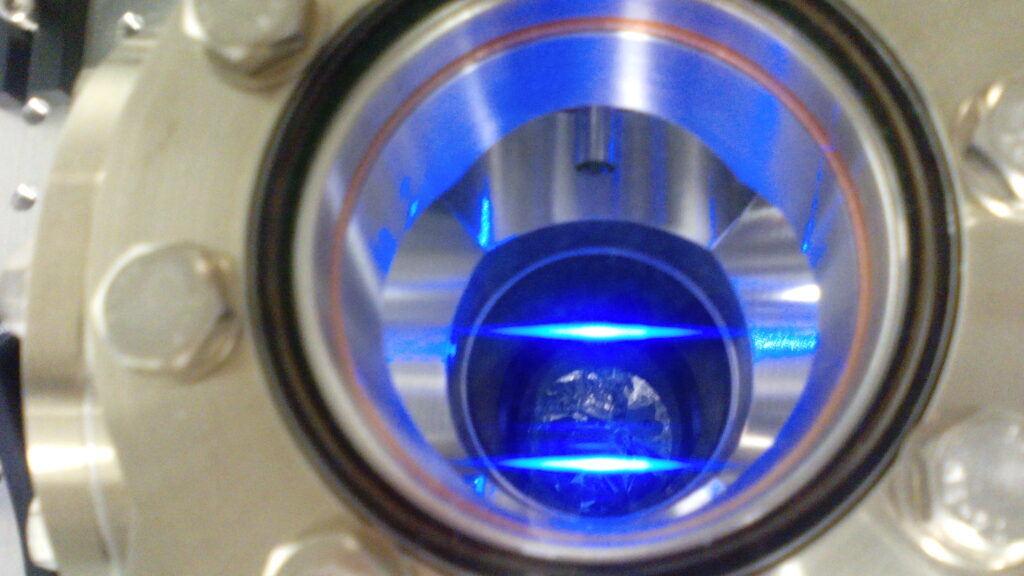
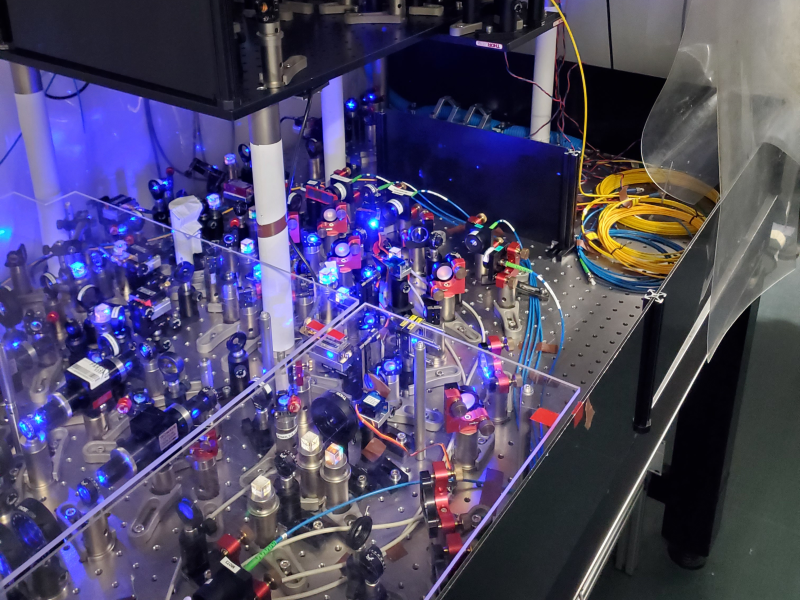
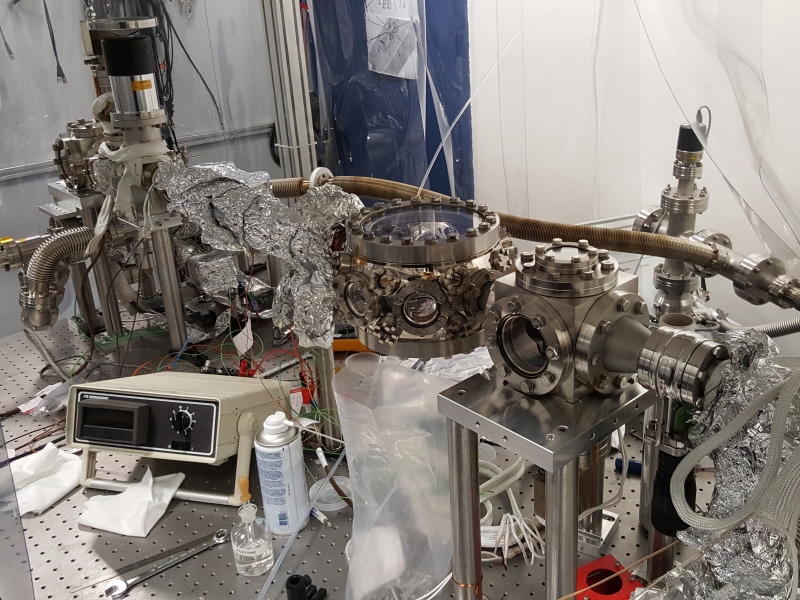
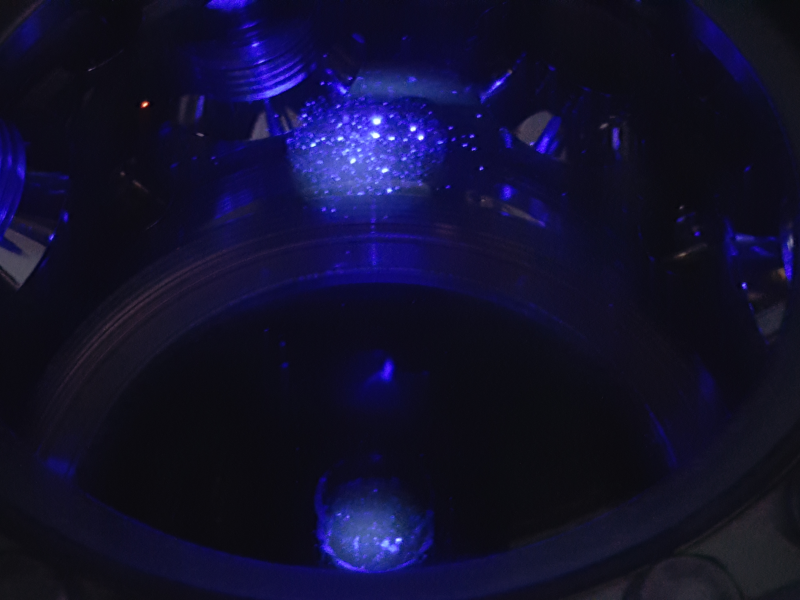
Quantum magnetism in ensembles of large spin atoms present possibilities beyond those offered by spin ½ electron gases and effective spin ½ atoms, such as magnetic phases with topological properties applicable to quantum information manipulation, or new mechanisms for the emergence of superfluidity. We have built an experimental apparatus that produces ultracold degenerate fermionic gases of strontium 87, with large spin F = 9/2, which we will arranged on periodic potentials produced by interfering lasers (optical lattices).
The large spin of strontium will enable us to emulate situations analog to those encountered by (spin 1/2) electrons in crystalline materials, but also a whole new set of situations that should contrast markedly with those. Furthermore, strontium 87 presents original interaction properties. Indeed, contrary to most species (e.g., chromium), the interactions between two particles do not depend on their spin projections: the Pauli principle, preventing two identical fermionic particles to meet each other and interact, is the only mechanism responsible for magnetism, which leads to an uncommon SU(N) spin rotation symmetry with large consequences on the magnetism.
Our system
On our system, we expect that novel magnetic states will emerge from the interplay between the lattice potential symmetry and the SU(N) spin rotation symmetry: while cubic lattices are suited for long range antiferromagnetic ordering of spin 1/2 particles, they are not expected to be for a large number of spin states. Conversely, triangular geometry may be more suited to antiferromagnetic ordering with three spin states than two. We aim at exploring the effect of these original properties on:
- the emergence of exotic magnetic phases, ranging from non-conventional spin ordering expected, e.g., for 3 populated spin states in a triangular lattice, to disordered phases such as chiral spin liquids for large number of populated spin states (up to 10 in our experiment). The latter present strong analogies with quantum frustrated magnets and with the topological properties of the quantum Hall states, and present possible applications to quantum information processing.
- the interplay between exotic magnetic properties and conduction properties when particle transport is allowed, in analogy with the “doping” of magnetic materials which led to the observation of high-Tc electron superconductors.
To reach these goals, our approach is to take advantage of the spectroscopic properties of strontium 87, using know-how from the frequency metrology community. We use the narrow lines of this atomic species – one of which is used in the context of optical clocks – to manipulate and probe the spin degree of freedom of the atomic ensembles. The narrow linewidths lead to unrivaled energy resolution, which we can use, e.g., to target the spins of specific atoms within inhomogeneous external fields (tomography), and to prepare deterministically specific spin patterns and reach towards low energy, low entropy many-body states.
Collaborations
- Emilia Witkowska, Polish Academy of Sciences
- John H Huckans, Bloosmburg University
- Marc Cheneau, Laboratoire Charles Fabry de l’Institut d’Optique
- Jérôme Lodewyck, LNE-SYRTE
- Rodolphe Le Targat, LNE-SYRTE
- Tommaso Roscilde, Ecole Normale Supérieure de Lyon
Project publications
Andrea Litvinov, Benjamin Pasquiou, Bruno Laburthe-Tolra, Etienne Maréchal, Husain Ahmed, John H. Huckans, Martin Robert-de-Saint-Vincent, Pauline Guesdon
We demonstrate coherent manipulation of the nuclear degrees of freedom of ultracold ground-state strontium-87 atoms, thus providing a toolkit for fully exploiting the corresponding large Hilbert space as a quantum resource and for quantum simulation experiments with 𝔰u(𝑁)-symmetric matter.
arXiv:2501.01731 (2025) / PRX Quantum 6, 020352 (2025)
Domantas Burba, Emilia Witkowska, Gediminas Juzeliūnas, Hubert Dunikowski, Martin Robert-de-Saint-Vincent
In this paper, we present a systematic derivation of the effective Hamiltonian for the nuclear spin states of ultracold fermionic atoms due to such an off-resonance light. We obtain compact expressions for the scalar, vector, and tensor light shifts taking into account both linear and quadratic contributions to the hyperfine splitting.
arXiv:2404.12429 (2024) / Phys. Rev. Research 6, 033293 (2024)
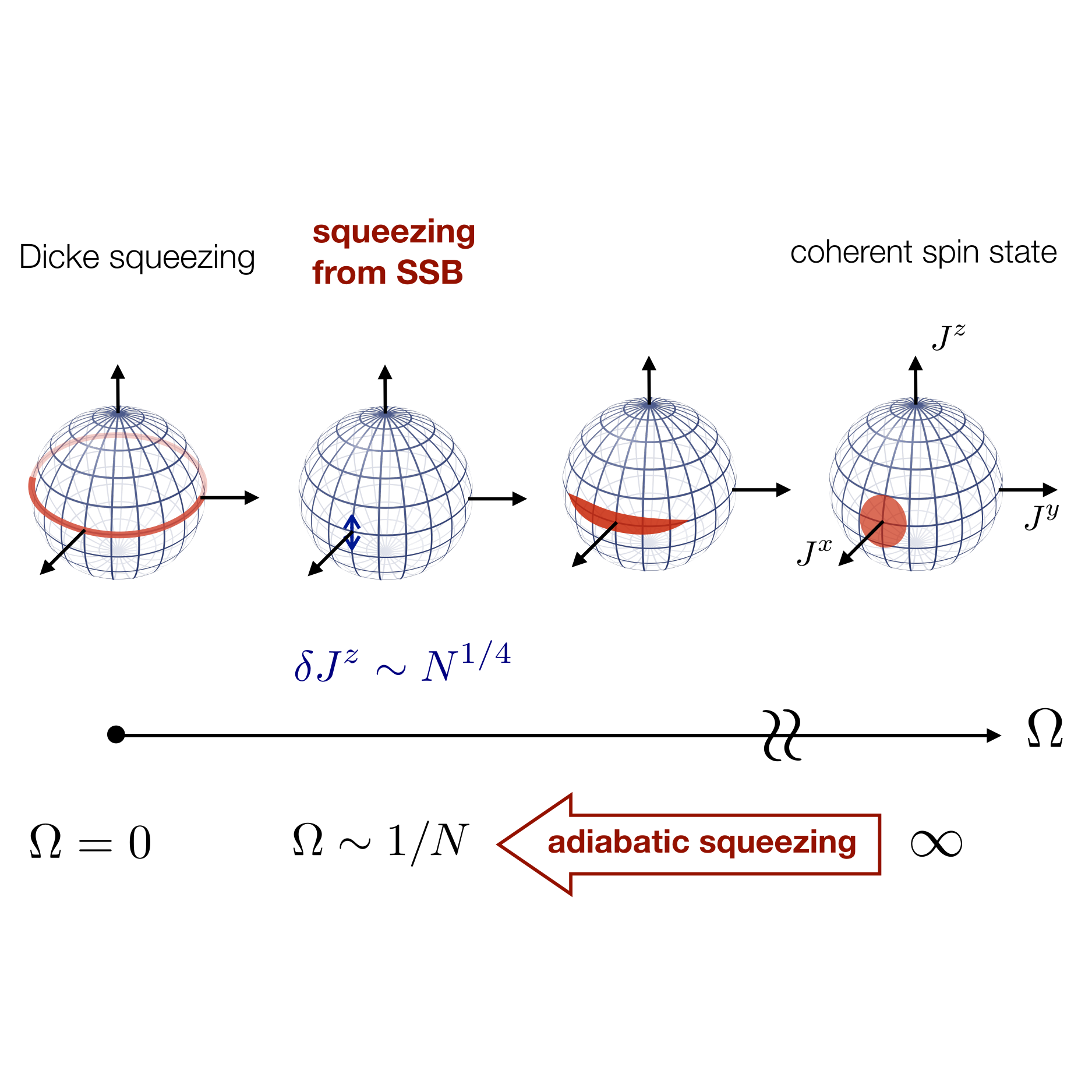
Spontaneous symmetry breaking is a property of Hamiltonian equilibrium states which, in the thermodynamic limit, retain a finite average value of an order parameter even after a field coupled to it is adiabatically turned off. In the case of quantum spin models with continuous symmetry, we show that this adiabatic process is also accompanied by the suppression of the fluctuations of the symmetry generator—namely, the collective spin component along an axis of symmetry.
arXiv:2202.08607 (2022) / Phys. Rev. Lett. 129, 113201 (2022)
Andrea Litvinov, Bruno Laburthe-Tolra, Etienne Maréchal, John H. Huckans, Martin Robert-de-Saint-Vincent, Olivier Gorceix, Paolo Pedri, Pierre Bataille
We propose and demonstrate an experimental method to measure by absorption imaging the size and local column density of a cloud of atoms, even when its smallest dimension is smaller than the resolution of the imaging system.
arXiv:2105.10296 (2021) / Physical Review A 104, 033309 (2021)
Albert Kaladjian, Andrea Litvinov, Bruno Laburthe-Tolra, Etienne Maréchal, Fabrice Wiotte, Isam Manai, John H. Huckans, Martin Robert-de-Saint-Vincent, Olivier Gorceix, Pierre Bataille
We introduce a spin-orbit coupling scheme, where a retroreflected laser beam selectively diffracts two spin components in opposite directions.
arXiv:2003.13444 (2020) / Phys. Rev. A 102, 013317 (2020)
Anais Molineri, Bruno Laburthe-Tolra, C. Duval, Clémence Briosne-Fréjaville, Etienne Maréchal, Fabrice Wiotte, Isam Manai, Marc Cheneau, Martin Robert-de-Saint-Vincent, Pierre Bataille, Romaric Journet
We present a spectroscopy scheme for the 7 kHz wide 689 nm intercombination line of strontium. We rely on shelving detection, where electrons are first excited to a metastable state by the spectroscopy laser before their state is probed using the broad transition at 461 nm.
arXiv:1910.11718 (2019) / J. Phys. B: At. Mol. Opt. Phys. 53 085005 (2020)
We consider a spin chain of fermionic atoms in an optical lattice, interacting with each other by super-exchange interactions. We theoretically investigate the dissipative evolution of the spin chain when it is coupled by magnetic dipole–dipole interaction to a bath consisting of atoms with a strong magnetic moment.
arXiv:1803.10663 (2018) / New J. Phys. 20 073037 (2018)
Bruno Laburthe-Tolra, Etienne Maréchal, John H. Huckans, Martin Robert-de-Saint-Vincent, Olivier Gorceix, William Dubosclard
While a number of experiments use heated sapphire windows to reduce strontium deposition and increase the viewport lifetime, here we study another possibility, consisting of sending the laser beam into the atomic flux by reflecting it off a mirror at 45 degree exposed to the strontium flux. We present our attempt to find a substrate that can be exposed to strontium and maintain high reflectivity.
arXiv:1802.08499 (2018)
Project news
New arrival: Lily Marquié
Generators of the SU(10) group
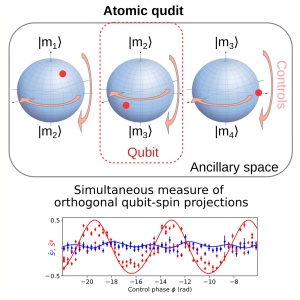
Now, with the implementation of evolution operators deriving from the generators of the SU(10) group, complete control over the quantum state of the nuclear spins is achievable. This is an opportunity to use the full Hilbert space of strontium 87 atoms in experiments and for quantum technologies, that we explore in our published paper. For example, we use it to measure simultaneously two non-commuting observables of pseudo-spin ensembles!
PhD defense: Husain Ahmed
New arrival: Alban Meyroneinc
New arrival: Pauline Guesdon
PhD defense: Andrea Litvinov
Congratulations to Andrea Litvinov for his PhD defense! Have a nice new Austrian Life, at F. Ferlaino group.
PhD defense: Pierre Bataille
Coherent control of the SU(10) spin
We have achieved coherent control of the SU(10) spin, with the implementation of adiabatic transfer between selected spin states in the degenerate gas. This puts us one step closer to exploring the emergence of correlations in our system, following the ideas developed in our collaboration with T. Roscilde and his team.
New arrival: Husain Ahmed
First experimental results using the degenerate Fermi gas
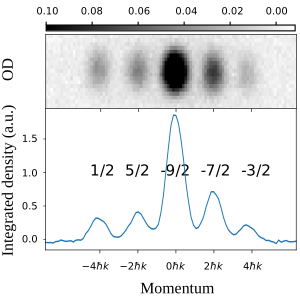
First experimental results using the degenerate Fermi gas! We used spin-orbit coupling to selectively manipulate and probe up to four selected spin states at once. We also present our new quantum gas machine setup, down to T/Tf ~ 0.2. Check it out here!
New spectroscopy scheme
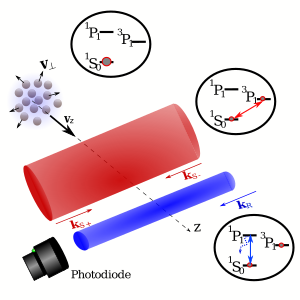
We concluded a great collaborative work with Marc Cheneau and his team, at Laboratoire Charles Fabry, on a new spectroscopy scheme for the intercombination line for strontium. For a large spectroscopy signal and a low complexity, look here.
New arrival: Andrea Litvinov
Fermionic degeneracy
Fermionic degeneracy reached! We now produce 10-component spinor Fermi gases of strontium 87, around half the Fermi temperature.
New arrival: Pierre Bataille
Strontium 88 ODT
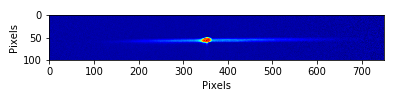
Narrow-line red magneto-optical trap
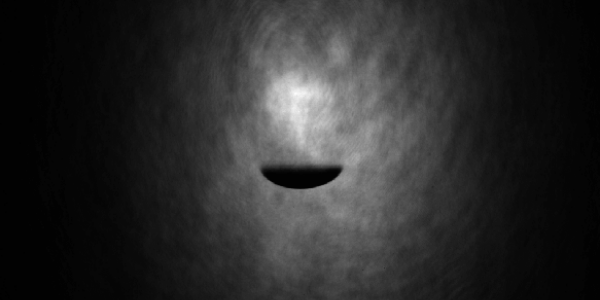
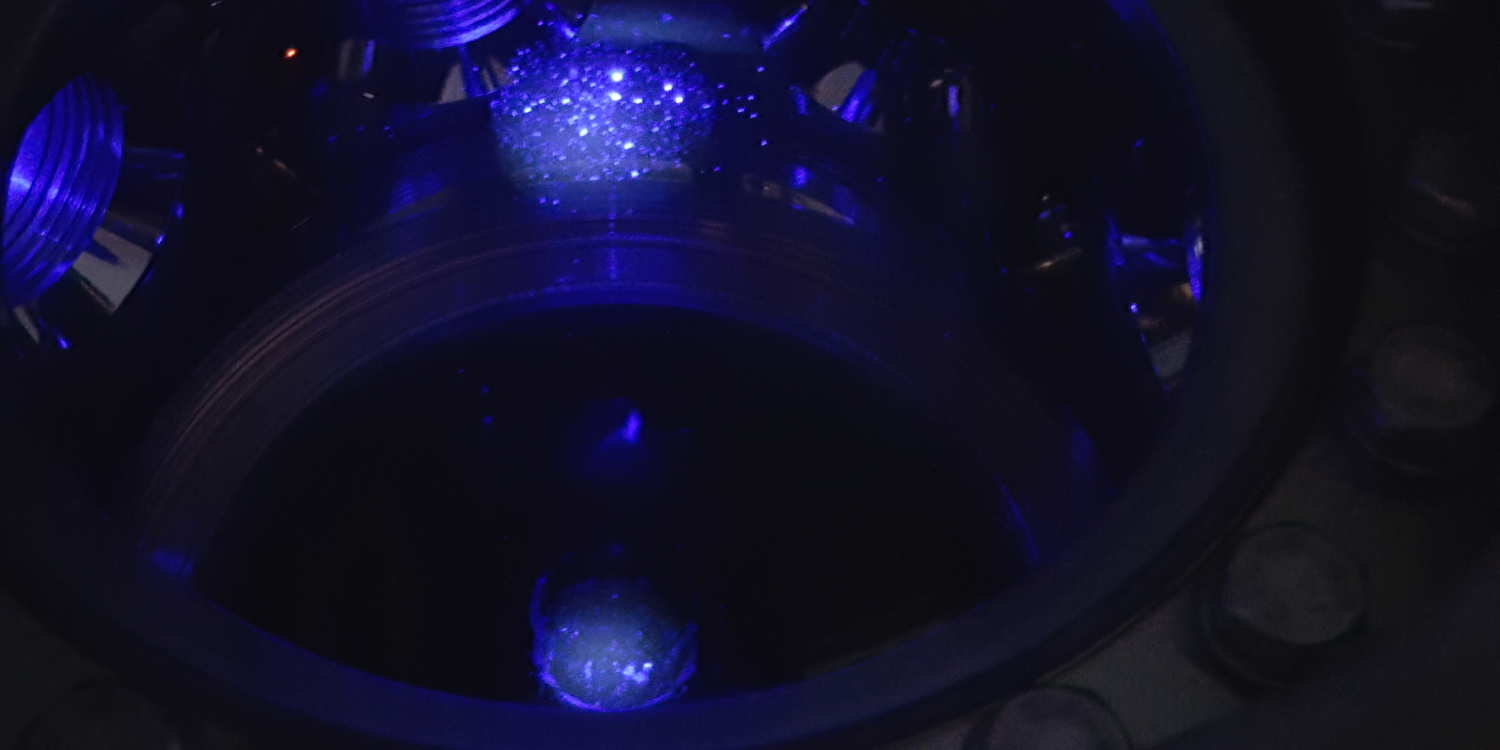
First blue magneto-optical trap.
End of bakeout
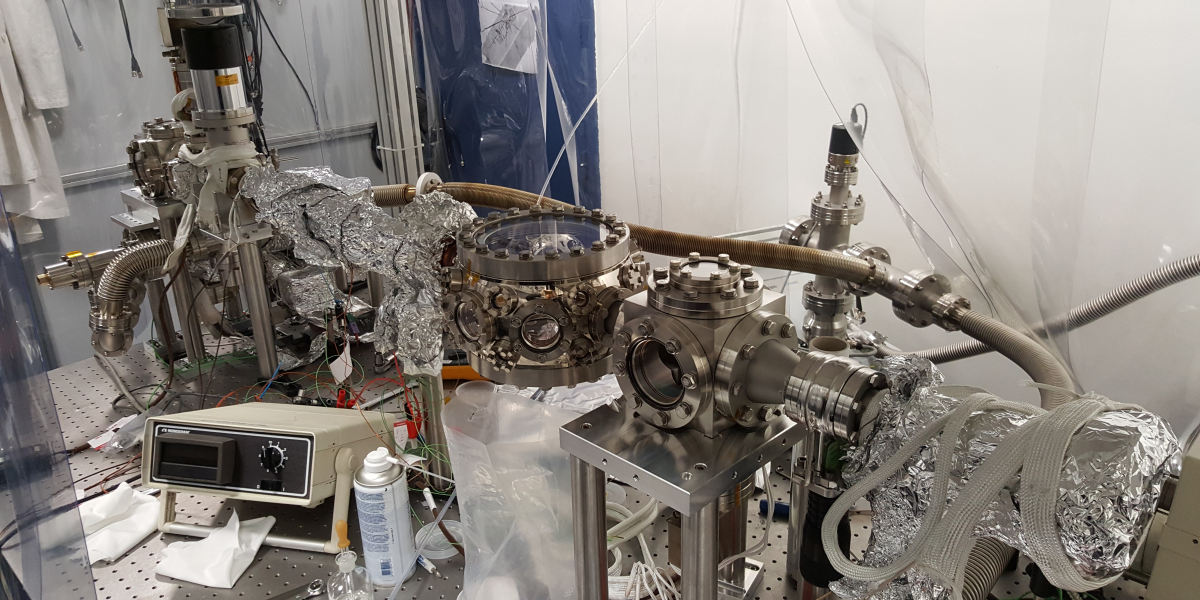
The bake-out is completed, the blue laser system is in place. Oven loading and laser cooling come next.
New arrival: Isam Manai
Welcome to Isam Manai, first post-doc on the strontium apparatus, taking on the challenge of building it!
Funding agencies
ANR, DIM Nano’K, DIM Sirteq, DIM Quantip, Labex FIRST-TF.