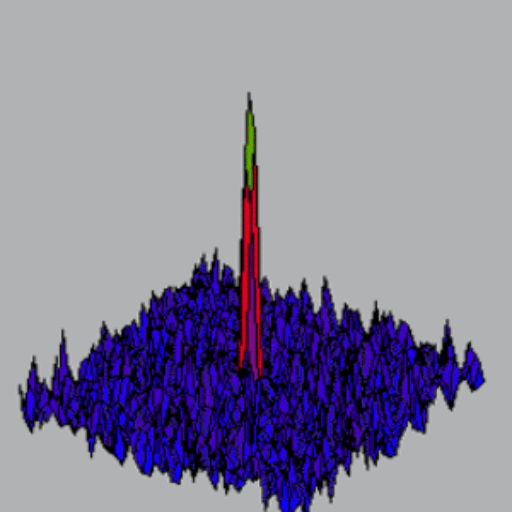
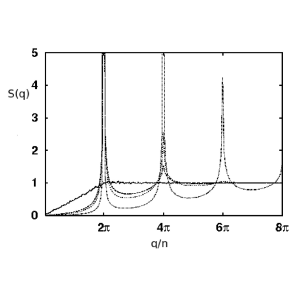
Probing 1D super-strongly correlated dipolar quantum gases
One-dimensional (1D) dipolar quantum gases are characterized by a very special condition where super-strong correlations occur to significantly affect the static and dynamical low-energy behavior.
Laser Phys. 19, 554 (2009) / HAL Id:ensl-00517334 (2010)
Seminar: ENS, Paris
Condensation du chrome et collisions assistées par champs radio-fréquence
Conference: Young Atom Opticians, Vienna
Dipolar relaxation in a chromium Bose-Einstein condensate
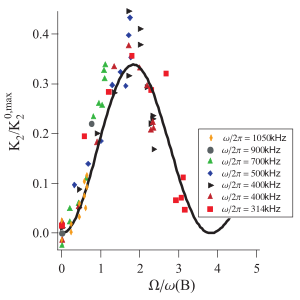
Radio-frequency association of molecules: the dressed state picture
We develop a theoretical model to describe the radio-frequency (RF) induced coupling of a pair of colliding atoms to a Feshbach molecule when a magnetic field arbitrarily far from the Feshbach resonance is modulated in time.
arXiv:0812.4355 (2008) / Eur. Phys. J. D 56, (2010)
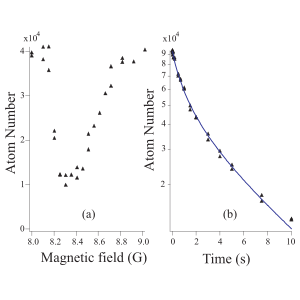
A Feshbach resonance in d-wave collisions
We analyze a narrow Feshbach resonance with ultracold chromium atoms colliding in 𝑑 wave. The resonance is made possible by dipole-dipole interactions, which couple an incoming 𝑙=2 collision channel with a bound molecular state with 𝑙=0.
arXiv:0811.4282 (2008) / Phys. Rev. A 79, 032706 (2009)
Seminar: IFRAF evaluation commitee, Paris
Bose-Einstein condensation in chromium and rf-assisted dipolar collisions
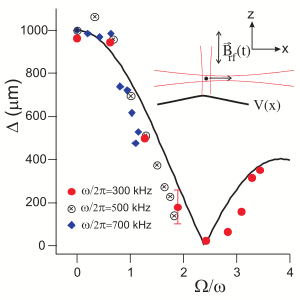
Radio-frequency-induced ground-state degeneracy in a Bose-Einstein condensate of chromium atoms
We study the effect of strong radio-frequency (RF) fields on a Bose-Einstein condensate (BEC) of chromium atoms, in a regime where the RF frequency is much larger than the Larmor frequency.
arXiv:0808.3931 (2008) / Phys. Rev. A 78, 051603(R) (200)
Seminar: NIST, Gaithersburg
All-optical production of chromium BECs – Bessel Engineering of Chromium
Colloquium: PAMO, Lille
Un condensat de chrome pour l’étude des interactions dipolaires
Workshop: Joint IFRAF – Holland workshop, Paris
All-optical formation of a chromium Bose-Einstein condensate